For years, utility-scale solar growth in the United States was primarily driven by decarbonization goals, renewable portfolio standards, and corporate sustainability commitments. Today, however, a new force is accelerating the energy transition at an unprecedented pace: artificial intelligence.
As AI adoption expands across nearly every industry, the demand for data centers has surged. These facilities require massive amounts of electricity to power servers, cooling systems, and increasingly complex computing workloads. According to the International Energy Agency (IEA), electricity consumption from data centers is expected to grow rapidly through 2030, with the United States accounting for a significant share of that increase. Some forecasts estimate that U.S. data center electricity demand could more than double within the next decade.
This growing demand is creating a major challenge for utilities and grid operators: how can new power needs be met quickly, reliably, and cost-effectively?
The answer, increasingly, is utility-scale solar paired with energy storage.
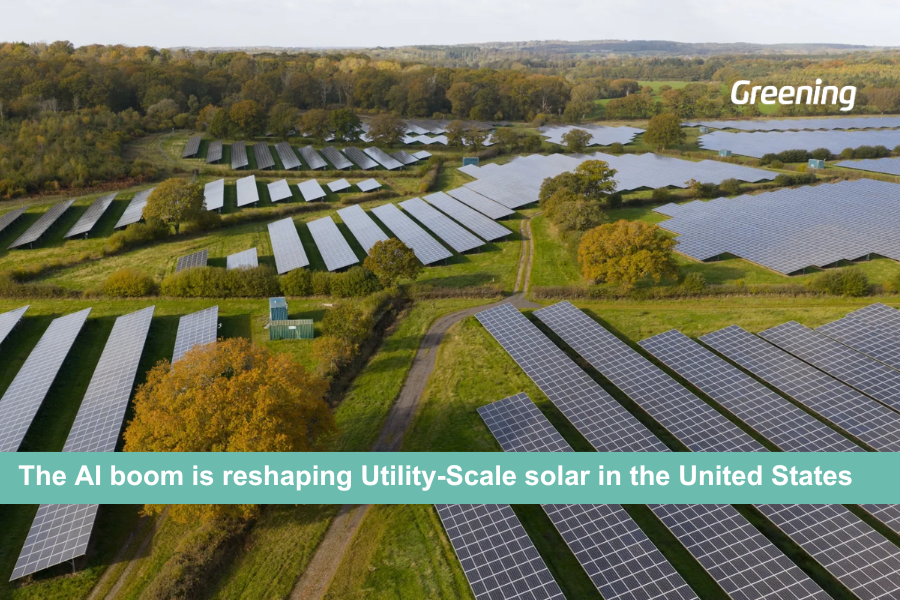
Unlike many conventional generation technologies that can require years of permitting and construction, utility-scale solar projects can often be developed faster and deployed at scale. The U.S. Energy Information Administration (EIA) expects solar to remain the fastest-growing source of electricity generation in the country, with nearly 70 GW of new solar capacity scheduled to come online during 2026 and 2027. Utility-scale solar generation is projected to increase significantly over the next two years as developers race to meet rising electricity demand.
Battery energy storage is becoming an equally important piece of the equation. Solar generation is inherently variable, but pairing solar with storage allows clean energy to be dispatched when it is needed most, improving grid flexibility and reliability. In the first quarter of 2026 alone, the United States installed a record 9.7 GWh of energy storage capacity, marking the strongest first quarter ever recorded for the sector.
This trend is particularly evident in regions experiencing rapid data center growth. States such as Texas, Virginia, Arizona, and Georgia are seeing increasing investment in both utility-scale solar and battery storage as developers seek to support large-scale electricity demand while maintaining long-term cost certainty. In ERCOT, for example, solar generation has steadily increased its share of the electricity mix, helping support one of the fastest-growing power markets in North America.
The implications extend beyond technology companies. Utilities, regulators, and independent power producers are all adapting to a future where electricity demand growth is returning after years of relative stagnation. Recently, the Federal Energy Regulatory Commission (FERC) called on grid operators to review how large electricity users such as data centers connect to the grid, highlighting the urgency of addressing new load growth while maintaining reliability.
At the same time, energy storage developers are expanding their pipelines in anticipation of continued demand. Industry forecasts suggest that data centers could account for a substantial portion of future electricity growth and drive significant investment in both storage and renewable generation. Experts increasingly view solar-plus-storage as one of the most scalable and economically viable solutions available to meet this challenge.
What makes this moment particularly significant is that utility-scale solar is no longer being viewed solely as a sustainability solution. It is becoming critical infrastructure for economic growth. The rapid expansion of AI, cloud computing, advanced manufacturing, and electrification is fundamentally changing how electricity demand evolves in the United States. As these industries continue to expand, utility-scale solar projects will play a central role in delivering the clean, affordable, and reliable energy needed to power the next generation of innovation.
For developers, investors, utilities, and energy consumers alike, the message is clear: the future of utility-scale solar is no longer defined only by climate goals. It is increasingly being shaped by the digital economy itself.
For more information:
info.us@greening-group.com