For years, one of the biggest challenges facing the solar industry was straightforward: making solar technology more affordable, efficient, and scalable.
That equation has changed.
Today, the United States has an enormous pipeline of renewable energy projects ready to move forward. Solar technology is mature, deployment continues at scale, and developers are planning gigawatts of new capacity.
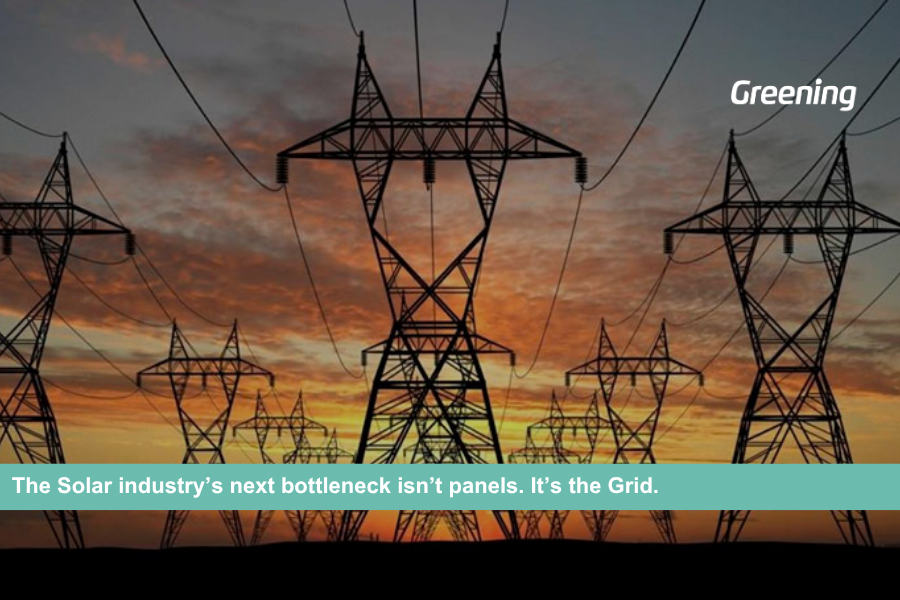
But increasingly, the question is no longer whether we can build more solar.
It is whether the grid can connect it.
More than 2,000 GW are waiting to connect
At the end of 2025, approximately 2,061 GW of generation and storage capacity were actively seeking interconnection to the U.S. transmission grid.
Solar alone represented approximately 773 GW, while another 749 GW of battery storage was waiting in interconnection queues (Lawrence Berkeley National Laboratory, 2026).
Those numbers demonstrate enormous interest in building new energy infrastructure across the country.
But being in the pipeline does not mean a project will reach commercial operation.
According to Berkeley Lab, only around 13% of the capacity that submitted interconnection requests between 2000 and 2020 had reached commercial operation by the end of 2025. Approximately 75% had been withdrawn.
And for the projects that do make it?
They are taking longer.
For projects completed in 2025, the median time between submitting an interconnection request and reaching commercial operation was more than five years in regions where sufficient data were available (Lawrence Berkeley National Laboratory, 2026).
That changes the economics of project development.
A great solar site is no longer enough
Historically, solar development focused heavily on fundamentals such as irradiation, available land, permitting conditions, environmental considerations, and proximity to infrastructure.
Those factors remain essential.
But today, another variable can make or break a project:
Can it actually connect to the grid?
A site can have excellent solar resources, favorable terrain, and hundreds of available acres. But if the surrounding transmission infrastructure cannot accommodate additional generation without significant upgrades, the project’s timeline, economics, and overall feasibility can change dramatically.
This is why interconnection strategy is becoming increasingly important from the earliest stages of project development.
Developers need to understand not only where solar resources are strongest, but where the electrical infrastructure can realistically support new generation.
In other words, the best solar project may not always be located where the sun is strongest.
It may be where generation can actually reach the grid.
Meanwhile, electricity demand is growing again
This challenge comes at a particularly important moment for the U.S. power system.
After years of relatively flat electricity consumption, U.S. power demand is growing again.
Between 2020 and 2025, electricity demand grew by approximately 1.7% annually, compared with just 0.1% annual growth between 2005 and 2019 (U.S. Energy Information Administration, 2026).
Data centers are playing a major role in that growth.
But they are not the only factor.
Advanced manufacturing, large industrial facilities, electrification and broader economic growth are also increasing pressure on electricity infrastructure.
In its 2026 National Transmission Needs Study, the U.S. Department of Energy identified a pressing need for additional transmission infrastructure, citing load growth, new generation interconnection, new load interconnection and congestion relief among the drivers (U.S. Department of Energy, 2026).
This creates an unusual situation.
The country needs more electricity.
Developers want to build more generation.
Customers need access to more power.
Yet the infrastructure connecting those pieces together is becoming one of the industry’s most important constraints.
The industry is responding
Interconnection reform is already underway.
FERC Order No. 2023 introduced reforms intended to improve generator interconnection procedures, while Order No. 1920 addressed long-term regional transmission planning and cost allocation (Federal Energy Regulatory Commission).
There are also early signs of progress.
Berkeley Lab reported that the total capacity waiting in interconnection queues decreased approximately 10% during 2025, while several regions processed record amounts of new interconnection agreements (Lawrence Berkeley National Laboratory, 2026).
Still, solving the challenge will require more than clearing existing queues.
The U.S. will need continued investment in transmission, better long-term grid planning and smarter coordination between generation, storage and new electricity demand.
The next phase of solar is about infrastructure
The solar industry has proven that it can build generation at an enormous scale.
The next challenge is making sure the infrastructure around those projects can be kept up.
For developers, investors and EPC partners, this means project success will increasingly depend on looking beyond modules and megawatts.
Interconnection strategy, transmission access, engineering, procurement, constructability and execution all need to be considered as interconnected parts of the same project.
Because ultimately, a solar project does not create value simply because it can generate electricity.
It creates value when that electricity can reliably reach the grid.
Building the infrastructure behind the energy transition
At Greening, we understand that successful utility-scale solar projects require much more than installing panels.
Our experience across renewable energy markets combines engineering, procurement, construction and project execution to help transform renewable energy opportunities into operating assets.
As the U.S. energy market evolves, delivering the next generation of solar infrastructure will require technical expertise, disciplined execution and a deep understanding of the challenges that exist between development and commercial operation.
Greening is committed to being part of that transformation, helping build the energy infrastructure needed to power the next chapter of U.S. growth.
For more information: info.us@greening-group.com