The United States is entering a new era of electricity demand growth. After years of relatively stable consumption, the country’s energy needs are accelerating rapidly, driven by the expansion of data centers, advanced manufacturing facilities, semiconductor plants, electrification initiatives, and industrial reshoring efforts.
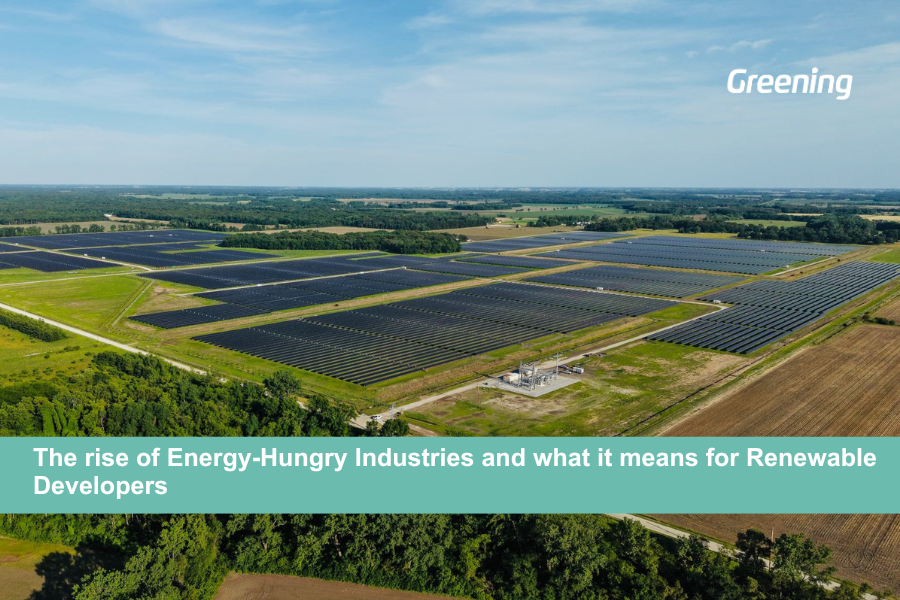
For solar developers, this shift represents one of the most significant opportunities the industry has seen in decades. As large energy users seek reliable, cost-effective, and sustainable power sources, utility-scale solar is increasingly becoming a critical component of the nation’s energy strategy.
A New wave of Electricity Demand
For much of the past decade, improvements in energy efficiency helped offset growth in electricity consumption. Today, however, several converging trends are reversing that pattern.
Artificial intelligence, cloud computing, and digital infrastructure are fueling an unprecedented boom in data center development. At the same time, federal and state initiatives aimed at strengthening domestic manufacturing have led to significant investments in sectors such as semiconductors, battery production, electric vehicles, and advanced materials.
Many of these facilities require enormous amounts of electricity to operate. A single hyperscale data center can consume as much electricity as a small city, while modern manufacturing facilities often demand continuous, high-capacity power around the clock.
According to industry forecasts, U.S. electricity demand is expected to grow substantially over the coming decade, creating new challenges for utilities, grid operators, and energy developers alike.
Why solar is becoming a Strategic Solution
As energy demand increases, companies are looking beyond traditional energy procurement strategies. Many organizations are seeking solutions that can provide long-term price certainty while supporting sustainability objectives and reducing exposure to energy market volatility.
Utility-scale solar has emerged as one of the most attractive options.
Technology offers some of the lowest-cost electricity generation available today, with predictable operating costs and scalable deployment capabilities. Solar projects can be developed relatively quickly compared to many conventional generation sources, making them well positioned to help address growing energy needs.
For large industrial users, solar energy can also support corporate decarbonization goals while providing a hedge against future increases in electricity prices.
As a result, renewable energy is increasingly viewed not only as an environmental initiative but as a strategic business decision.
Data Centers are reshaping Energy Markets
Among the industries driving this transformation, data centers stand out as one of the most influential.
The rapid adoption of artificial intelligence is dramatically increasing computing requirements, leading technology companies to expand their infrastructure footprints across the country. Major operators are actively securing long-term energy agreements to support new facilities while meeting ambitious sustainability commitments.
This trend is creating substantial demand for utility-scale solar and energy storage projects, particularly in regions with favorable development conditions and strong transmission infrastructure.
For solar developers, partnerships with data center operators and technology companies are becoming an increasingly important pathway for project growth.
Manufacturing and Industrial reshoring create new opportunities
The resurgence of domestic manufacturing is generating another significant source of demand.
Across the United States, companies are investing billions of dollars in new production facilities, particularly in sectors such as semiconductors, batteries, electric vehicles, and advanced industrial manufacturing.
These projects often require large volumes of electricity and long-term energy procurement strategies. Many organizations are exploring power purchase agreements (PPAs), virtual PPAs, and other renewable energy solutions to manage costs and support sustainability commitments.
For developers, this creates opportunities to deliver large-scale renewable energy projects that align with both operational and environmental objectives.
The Growing Role of energy storage
While solar generation will play a major role in meeting future energy demand, energy storage is becoming increasingly important as part of the solution.
Battery Energy Storage Systems (BESS) help improve grid flexibility, support reliability, and enable greater integration of renewable energy resources. As industrial energy consumption continues to grow, the combination of utility-scale solar and storage is expected to become an increasingly common strategy for delivering dependable, cost-effective power.
Developers that can integrate storage into their project portfolios will be well positioned to address the evolving needs of large energy consumers.
What this means for Solar Developers
The growth of energy-intensive industries is reshaping the U.S. energy landscape and creating a long-term need for new generation capacity.
For solar developers, the opportunity extends beyond simply adding renewable megawatts to the grid. Success will increase depending on understanding the specific energy requirements of large consumers, identifying strategic locations with strong transmission access, and delivering projects capable of supporting long-term energy demand growth.
As data centers, manufacturing facilities, and industrial operations continue to expand, utility-scale solar is expected to play a central role in powering the next generation of economic development across the United States.
Looking Ahead
The convergence of artificial intelligence, industrial reshoring, and electrification is creating one of the strongest growth environments the U.S. energy sector has experienced in years.
Meeting this demand will require substantial investment in new infrastructure, transmission capacity, renewable generation, and energy storage solutions.
For solar developers, this represents more than a market trend, it is a structural transformation that is redefining how electricity is generated, procured, and consumed. Companies that are prepared to support this transition will play a critical role in building the energy systems needed to power America’s next phase of growth.
For more information: info.us@greening-group.com