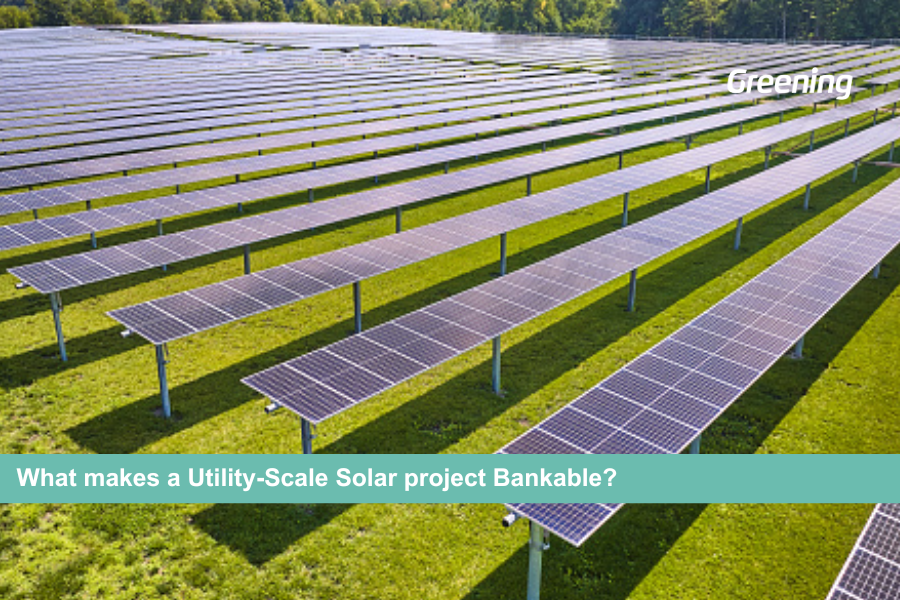
What makes a Utility-Scale Solar project Bankable?
As utility-scale solar continues to expand across the United States, the conversation is evolving beyond how much energy a project can generate. For developers, investors, and offtakers, another question matters just as much:
Can the project deliver long-term value with a clear path to execution and predictable returns?
That is where bankability comes in.
A bankable solar project is one that gives lenders and investors confidence that it can be successfully developed, financed, built, and operated over its expected lifetime. While every project is different, several key factors play a role in turning a solar opportunity into a viable long-term energy asset.
The right Site
Location is one of the first building blocks of a successful utility-scale solar project.
Solar resources, available land, environmental considerations, access to infrastructure, and proximity to transmission all influence a project’s potential. But finding suitable land is only part of the equation.
A strong site must also have a realistic path to grid interconnection. As interconnection queues continue to grow in several U.S. markets, understanding transmission availability and grid constraints early in development has become increasingly important.
The best solar resource does not necessarily make the best project if the electricity cannot efficiently reach the grid.
A clear Interconnection Strategy
For utility-scale projects, getting connected to the grid can be just as important as building the project itself.
Interconnection studies help determine whether the existing grid can accommodate a project’s generation and what upgrades may be required. These costs, timelines, and technical requirements can significantly influence a project’s economics.
That makes interconnection strategy a critical consideration from the early stages of development—not something to address once the project is ready for construction.
Proven technology
Technology selection directly impacts a project’s performance and long-term economics.
Modern utility-scale projects can incorporate technologies such as high-efficiency modules, single-axis trackers, bifacial panels, advanced monitoring systems, and battery energy storage systems (BESS).
But the goal is not simply to select the newest technology.
The key is selecting technology that is proven, appropriately sized, financeable, and capable of performing reliably over the project’s lifecycle.
Bankability depends on confidence in both the technology and the companies standing behind it.
A strong Offtake Strategy
Producing electricity is only one side of the equation. A project also needs a clear strategy for monetizing that energy.
Power Purchase Agreements (PPAs), merchant structures, and other offtake arrangements can provide different approaches to revenue generation and risk management.
For many projects, a well-structured PPA can provide long-term revenue visibility while helping an offtaker secure renewable electricity at a predictable price.
Ultimately, the strength of the offtake strategy can have a significant impact on a project’s ability to attract financing.
Execution matters
A great project on paper still needs to be built.
Engineering, Procurement and Construction (EPC) plays a critical role in translating a project’s development plan into an operational asset.
Schedule management, procurement, construction quality, safety, equipment availability, and cost control all influence whether a project reaches commercial operation as planned.
This is why experienced EPC partners can add value well beyond construction. Strong execution reduces uncertainty and helps transform a development opportunity into a reliable operating asset.
Long-Term performance
Bankability does not end when a solar project reaches commercial operation.
Utility-scale solar assets are designed to operate for decades, making long-term performance and asset management essential components of their value.
Operations and maintenance, performance monitoring, predictive maintenance, equipment management, and data-driven optimization can all help maximize energy production throughout the project’s lifecycle.
In other words, the long-term value of a solar project depends not only on how it is built, but on how well it performs over time.
Building projects that stand the test of time
The U.S. utility-scale solar market is entering a more sophisticated phase. As projects become larger, more technologically advanced, and increasingly integrated with storage, successful development requires more than strong solar resources.
It requires the right combination of site selection, grid strategy, technology, financing, offtake, EPC execution, and long-term asset management.
At Greening US, we understand that every successful solar project starts with a strong foundation. Through our integrated approach to renewable energy development and project execution, we help turn complex energy opportunities into high-quality, reliable, and long-term renewable energy assets.
As the U.S. continues building the next generation of its energy infrastructure, we’re ready to help bring the right projects from opportunity to operation.
Looking to develop your next utility-scale solar project?