For decades, states competed for major investments with a familiar playbook: tax incentives, available land, transportation infrastructure, and a skilled workforce.
Today, another factor is moving rapidly up the list: power.
The expansion of artificial intelligence, cloud computing, advanced manufacturing, semiconductor facilities, and other energy-intensive industries is creating a new wave of electricity demand across the United States. For companies deciding where to build their next facility, access to reliable, scalable, and cost-competitive energy is becoming increasingly important.
That is creating a new kind of competition between states, one where energy infrastructure can become an economic development advantage.
Electricity demand is growing again
For years, U.S. electricity demand remained relatively flat. That trend has changed.
According to the U.S. Energy Information Administration (EIA), electricity demand increased by an average of approximately 2.1% per year between 2020 and 2025, compared with just 0.1% annually between 2005 and 2019. Data centers have become an important contributor to this growth.
And the acceleration is continuing.
The EIA expects U.S. electricity sales to reach approximately 4,135 billion kWh in 2026 and 4,211 billion kWh in 2027. Commercial and industrial customers, including data centers and manufacturing facilities, account for most of the expected increase.
This matters because many of the facilities driving America’s next investment cycle require enormous amounts of electricity, and they need it reliably.
A state may have available land, attractive incentives, and proximity to major markets. But if the grid cannot accommodate a project’s electricity requirements within the necessary timeline, energy itself can become a constraint on development.
Virginia shows the scale of the data center boom
Few places illustrate this transformation better than Virginia.
Northern Virginia has become one of the world’s largest concentrations of data centers, and that growth is visible directly in electricity consumption.
Between 2019 and 2025, commercial electricity sales in Virginia increased by nearly 30 million MWh, according to the EIA. The agency says the increase has been driven largely by the state’s concentration of data centers, alongside building electrification and electric vehicle adoption.
Virginia demonstrates an increasingly important reality: attracting digital infrastructure means planning for energy infrastructure at the same time.
Data centers are not simply another category of commercial real estate. Their electricity requirements can reshape regional load forecasts, generation needs, transmission planning, and the timing of new energy projects.
Texas faces a different version of the same challenge
Texas is another major example.
The state combines rapid population growth, industrial expansion, manufacturing investment, and increasing data center development, all within an electricity market already managing substantial demand.
The EIA expects ERCOT, which manages most of the Texas grid, to be among the regions experiencing the fastest electricity demand growth from data centers through 2027. The agency also identifies Texas and Virginia as major contributors to rising commercial and industrial electricity demand.
Texas also demonstrates why this issue extends beyond data centers.
New factories, logistics hubs, advanced manufacturing facilities, and other industrial developments all need electricity. As more projects arrive simultaneously, states and grid operators must determinenot only how much new generation is required, but also how quickly it can be connected and delivered where demand is growing.
Energy is becoming part of the site-selection equation
The result is a subtle but significant change in economic development.
Companies traditionally asked:
Where can we find land? Where are the workers? What incentives are available?
Increasingly, another question belongs alongside them:
Where can we get the power we need, and how quickly?
That changes the competitive landscape.
Regions capable of adding generation, expanding transmission, accelerating interconnection, and integrating new energy resources may be better positioned to accommodate future electricity-intensive development.
Renewable energy has an important role to play in that equation.
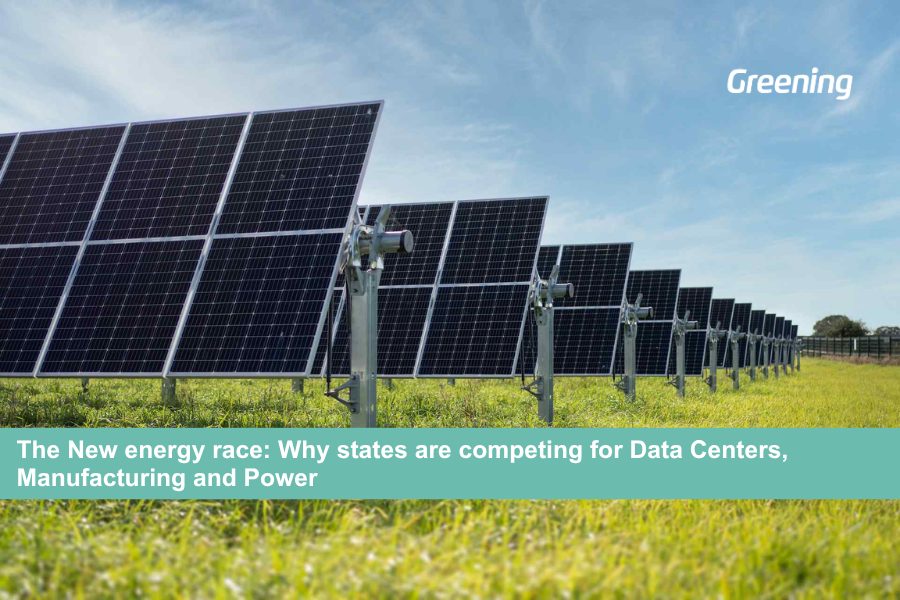
Solar can add generation capacity relatively quickly compared with many traditional infrastructure projects. Battery energy storage can help shift electricity across different periods of the day and provide additional flexibility. And distributed generation can allow commercial and industrial facilities to produce a portion of their electricity closer to where it is consumed.
None of these technologies solves the challenge alone. But together with transmission, conventional generation, grid modernization, and demand-side solutions, they expand the options available to a rapidly changing electricity system.
The next economic race may also be an energy race
America’s economic geography has always been shaped by infrastructure.
Railroads influenced where industrial cities developed. Highways transformed manufacturing and logistics. Fiber networks helped determine where the digital economy could grow.
Electricity infrastructure may increasingly play a similar role in the next wave of U.S. investment.
The EIA expects data center development and increased manufacturing activity to continue driving electricity growth in the near term. Over the longer term, its 2026 outlook projects that installed U.S. generating capacity could increase substantially as the power system adapts to rising demand.
For states, utilities, developers, and businesses, the opportunity is no longer simply about producing more electricity.
It is about building an energy system capable of supporting where the American economy wants to grow next.
At Greening, we develop renewable energy solutions designed to support a more resilient, competitive, and sustainable energy future, from distributed generation to large-scale renewable projects.
Looking for an energy solution for your business or project? Contact us at info.us@greening-group.com to explore how renewable energy can support your growth.