The U.S. utility-scale solar industry is growing at an unprecedented pace. According to the U.S. Energy Information Administration (EIA), developers are expected to add more than 43 GW of new utility-scale solar capacity in 2026: a 60% increase compared to the previous year. Solar is also projected to account for more than half of all new power generation capacity added to the grid.
This rapid growth is undoubtedly a positive sign for the energy transition. However, it is also creating a new challenge for the industry: how to maintain quality while building at scale.
For years, the conversation around utility-scale solar has focused on cost reductions, deployment speed, and project volume. Today, a different topic is gaining attention among developers, investors, utilities, and asset owners: long-term project quality.
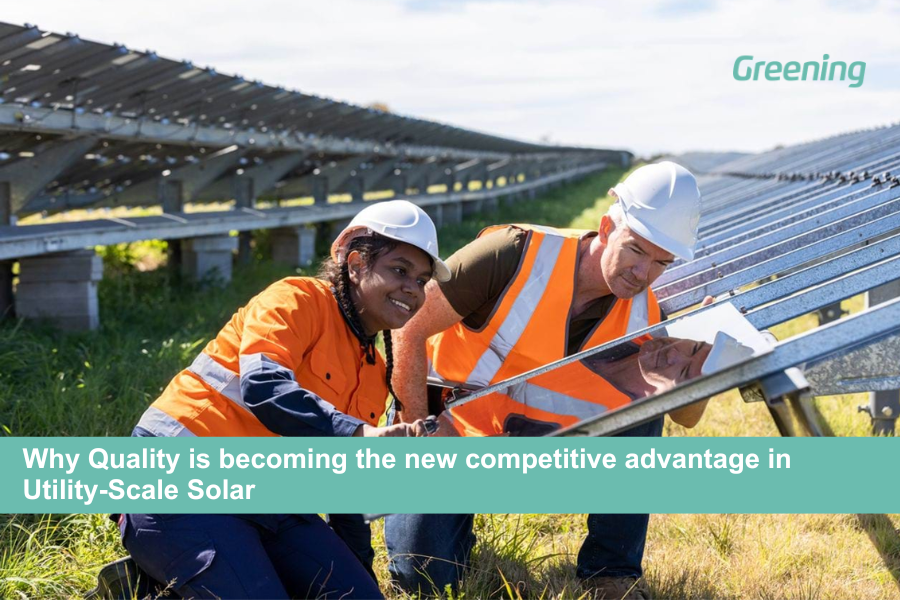
As solar projects become larger, more complex, and increasingly important to grid reliability, quality is emerging as one of the most important factors determining long-term project success.
The Industry is growing faster than ever
The utility-scale solar market continues to break records. Solar capacity has now surpassed wind in the United States, and industry forecasts indicate continued growth through the remainder of the decade. At the same time, electricity demand is rising due to industrial growth, electrification, and broader economic expansion.
Yet growth brings pressure.
Developers face tighter schedules, labor shortages, supply chain constraints, and increasing complexity throughout the project lifecycle. Industry analysts have identified workforce availability, procurement challenges, and interconnection bottlenecks as some of the most significant hurdles facing utility-scale solar projects today.
In this environment, delivering projects quickly is no longer enough. Stakeholders are placing greater emphasis on ensuring projects perform reliably over their entire operational lifespan.
The Hidden cost of poor quality
A utility-scale solar plant is designed to operate for decades. Small issues during engineering, procurement, or construction can create long-term operational challenges that affect energy production, maintenance costs, and asset value.
Installation defects, inadequate documentation, equipment handling errors, connector failures, and commissioning oversights may not always be visible during construction, but they can impact performance years later. Industry best-practice organizations continue to emphasize quality assurance throughout the entire project lifecycle, from design and procurement through construction and commissioning, to improve reliability and long-term outcomes.
For project owners and investors, quality is increasingly viewed as a risk management strategy. A project delivered on time and on budget is important, but a project that consistently performs as expected over 30 years ultimately creates far greater value.
Quality starts long before Construction
Quality is often associated with construction activities, but in reality, it begins much earlier.
Project design, equipment selection, procurement strategies, logistics planning, and quality control procedures all contribute to long-term project performance. Decisions made before ground is broken can have lasting implications for reliability, maintainability, and energy production.
As supply chains become more dynamic and material costs fluctuate, project teams must carefully balance speed, cost, and quality. Recent market disruptions affecting key materials used in solar projects have highlighted the importance of robust procurement and project planning processes.
Successful projects increasingly rely on strong coordination across every phase of development and execution.
Why EPC experience matters more than ever
As utility-scale projects continue to grow in size and complexity, developers are placing greater value on experienced EPC partners that can deliver consistent execution, maintain rigorous quality standards, and effectively manage project risks.
A successful EPC approach goes beyond construction. It requires disciplined planning, quality assurance procedures, workforce management, safety programs, documentation controls, and thorough commissioning processes. Industry experts continue to identify operational excellence and quality management as key differentiators for long-term project success.
At Greening, we understand that project quality is built through collaboration across the entire value chain. This is why we work alongside our EPC construction partner, Greensol Renewables, whose experience in utility-scale solar construction helps support the safe, efficient, and reliable delivery of projects throughout the United States.
Looking ahead
The next chapter of utility-scale solar growth will not be defined solely by how many projects are built. It will also be defined by how well they perform over time.
As the industry continues to scale, quality is becoming more than a technical consideration, it is becoming a competitive advantage.
Developers, utilities, investors, and EPC firms that prioritize quality throughout the project lifecycle will be better positioned to maximize asset performance, reduce operational risks, and create long-term value in an increasingly competitive energy market.
For more information:
Greening: info.us@greening-group.com
Greensol: info@green-sol.us