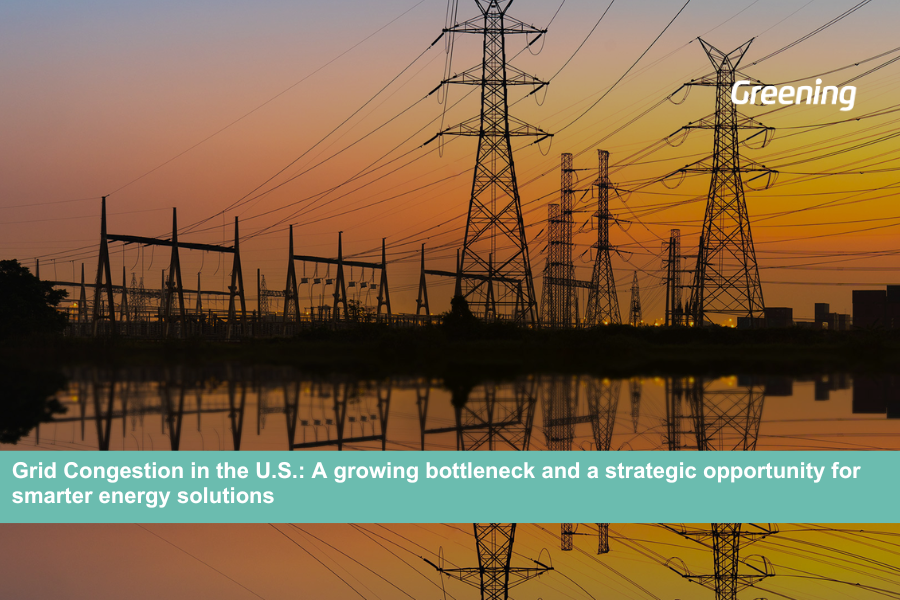
The U.S. power grid is under unprecedented pressure. As renewable capacity expands rapidly and electricity demand surges, driven by electrification, manufacturing reshoring, and AI-powered data centers, grid congestion has emerged as one of the most critical bottlenecks in the energy transition.
What was once a technical constraint is now a strategic and financial challenge for developers, utilities, and corporate energy buyers alike.
The Scale of the problem
Grid congestion occurs when transmission infrastructure cannot carry all the electricity being generated to where it is needed. In recent years, this issue has intensified across major U.S. markets, particularly in regions with strong renewable penetration such as ERCOT, CAISO, PJM, and MISO.
According to the U.S. Department of Energy, interconnection queues now exceed 2,000 GW of proposed generation capacity, with renewables representing most projects waiting for grid access (DOE, 2023). Many of these projects face multi-year delays and escalating upgrade costs.
At the same time, congestion costs in wholesale markets have risen significantly, impacting project economics and creating revenue uncertainty for asset owners (FERC, 2024). Curtailment—when renewable generation is reduced due to grid constraints—has become increasingly common, especially during peak solar production hours (EIA, 2023).
In short, the grid was not built for today’s distributed, renewable-heavy energy landscape.
Why Congestion is more than a utility problem
While transmission operators work to expand and modernize infrastructure, grid upgrades require long permitting timelines, regulatory coordination, and substantial capital investment. The American Clean Power Association estimates that transmission development can take up to a decade from planning to operation (ACP, 2024).
For developers and corporate energy buyers, waiting is not always an option.
Grid congestion directly affects:
- Project bankability and PPA pricing
- Interconnection timelines
- Energy price volatility
- Corporate decarbonization roadmaps
In this context, businesses are increasingly looking for solutions that reduce exposure to grid risk rather than depending entirely on large-scale transmission expansion.
How the market is adapting
The industry is responding with smarter, more flexible energy strategies.
One of the most significant trends is the integration of Battery Energy Storage Systems (BESS). Storage allows projects to shift energy to higher-value hours, reduce curtailment risk, and improve grid stability (NREL, 2024). Hybrid solar-plus-storage projects are becoming a preferred model in congested regions because they enhance interconnection value and revenue resilience.
Another growing solution is onsite generation for commercial and industrial (C&I) clients. Behind-the-meter solar and storage systems reduce reliance on constrained transmission infrastructure while providing predictable energy costs and improved energy security.
Storage systems, such as batteries, reduce grid congestion by acting as flexible buffers that store excess energy during periods of low demand or high renewable generation (peak production) and discharging it when demand is high, preventing transmission lines from exceeding their capacity. This process, often called peak shaving or shifting, alleviates bottlenecks and stabilizes the grid, reducing the need for costly, real-time grid balancing and minimizing energy curtailment.
- Peak Shaving and Load Management: Storage systems store electricity during off-peak hours and discharge it during peak demand times, reducing the immediate load on transmission and distribution lines.
- Mitigating Renewable Volatility: Batteries absorb excess energy from wind or solar farms when production is high and demand is low, preventing the grid from becoming overloaded (curtailment) and storing it for later use.
- Reducing Congestion Costs: By managing the flow of electricity, storage systems reduce the need for expensive “redispatch” measures where grid operators pay to turn down generation in congested areas.
- Improved Grid Resilience: Storage systems provide on-demand, local energy, enhancing the stability and reliability of the grid, particularly in areas with high renewable penetration.
- Enhancing Infrastructure Efficiency: By acting as a buffer, storage systems allow for more efficient utilization of existing transmission lines, postponing or reducing the need for costly new infrastructure, such as building new transmission lines
Turning a bottleneck into an opportunity
Grid congestion will not disappear overnight. But it is accelerating the evolution of how energy projects are designed, financed, and deployed in the United States.
Developers that combine generation, storage, engineering optimization, and market intelligence are better positioned to navigate congestion challenges. The ability to structure hybrid solutions, optimize interconnection strategies, and provide flexible PPA models is becoming a competitive advantage in today’s market.
At Greening US, we see grid constraints not simply as barriers, but as catalysts for smarter energy solutions. As a vertically integrated renewable energy company with expertise in solar generation, storage integration, and tailored energy structures, we help clients reduce grid dependency, mitigate congestion risks, and secure long-term energy stability.
In an increasingly constrained grid environment, resilience and optimization define success. The future of energy in the U.S. will belong to those who design beyond the bottleneck,and build solutions that work with the grid, not against it.
Contact us: info.us@greening-group.com