Navigating uncertainty while unlocking long-term value
The U.S. energy landscape is evolving rapidly. Over the past few years, federal and state policies have played a critical role in accelerating the adoption of renewable energy. However, recent legislative updates, shifting political priorities, and growing grid constraints are introducing a new layer of complexity for companies evaluating solar and storage projects.
For commercial and industrial (C&I) players, this is creating a key question: how do you move forward with energy investments in an environment that is no longer as predictable as it once seemed?
A shifting policy environment
The Inflation Reduction Act (IRA) marked a turning point for renewable energy in the United States, extending and expanding tax incentives such as the Investment Tax Credit (ITC) and introducing new benefits for standalone energy storage.
However, more recent developments, particularly at the federal and state levels, are beginning to reshape how these incentives are accessed and how projects are structured.
Among the most relevant dynamics:
- Increased scrutiny and evolving requirements around domestic content and labor compliance
- Delays and bottlenecks in interconnection processes, limiting how quickly projects can come online
- State-level policy divergence, with some states accelerating clean energy adoption while others introduce additional barriers
- Ongoing political uncertainty, which may impact the long-term stability of certain incentives
While incentives are still available, the pathway to capturing their full value is becoming more complex.
What this means for solar and storage projects
For companies considering onsite generation or energy procurement strategies, policy is no longer just a financial lever, it is a structural factor that shapes feasibility, timelines, and returns.
Incentives still matter, but they are no longer the only driver
Tax credits such as the ITC continue to play an important role in improving project economics. The inclusion of standalone storage has been particularly impactful, enabling more flexible and resilient system designs.
However, leading companies are no longer relying solely on incentives to justify projects. Instead, they are focusing on long-term energy cost reduction, price stability, and operational resilience.
Interconnection is becoming a critical bottleneck
Across many U.S. markets, interconnection queues are growing, and approval timelines are becoming less predictable.
This is pushing companies to explore behind-the-meter solutions, where onsite solar and storage can reduce dependence on grid upgrades and accelerate deployment timelines.
Energy reliability is now a business priority
Extreme weather events, grid congestion, and rising demand, especially from data centers and electrification, are increasing the risk of disruptions.
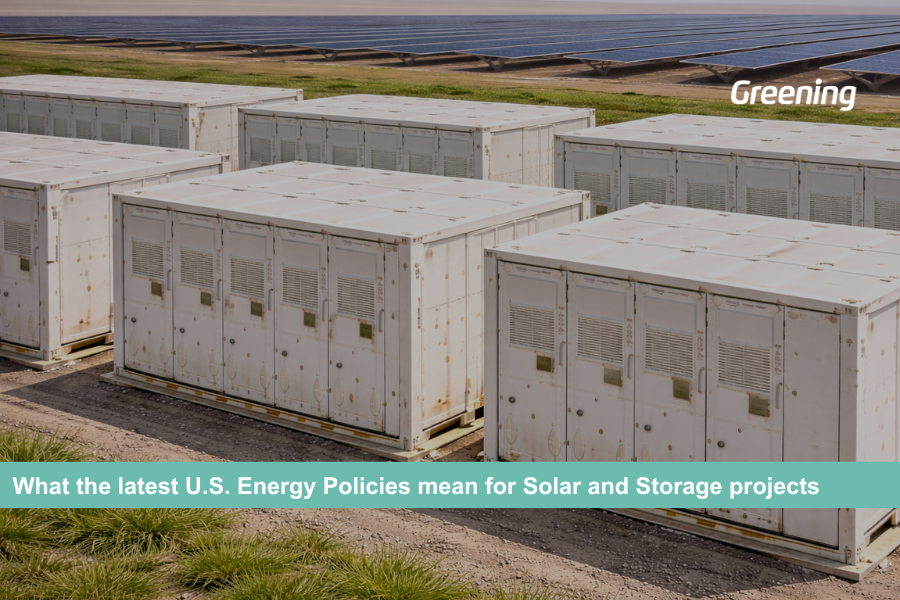
As a result, storage is no longer seen as an optional add-on. It is becoming a core component of energy strategy, enabling peak shaving, backup capabilities, and greater control over energy use.
Policy complexity requires a more strategic approach
With varying rules across states and evolving federal guidelines, structuring a project today requires a deeper understanding of:
- Incentive eligibility and compliance requirements
- Market-specific regulations
- Utility frameworks and tariffs
- Long-term contractual structures
This complexity is driving a shift: companies are moving from transactional decisions to strategic energy planning.
The rise of flexible energy models
In this new environment, flexibility is key. One of the models gaining the most traction is the Onsite Power Purchase Agreement (PPA).
Through this structure:
- A third-party developer finances, builds, and operates the system
- The customer purchases energy at a predictable, often lower rate
- The project can be optimized to capture available incentives without requiring upfront capital from the client
This approach allows companies to benefit from solar and storage while mitigating regulatory and financial risk.
Solar + storage: from opportunity to necessity
The combination of solar generation and battery storage is becoming one of the most effective ways to navigate today’s policy and market conditions.
Together, they enable:
- Greater independence from grid volatility
- Optimization of energy consumption and demand charges
- Enhanced resilience during outages
- Improved alignment with ESG and decarbonization goals
As policies evolve, integrated solutions offer a more future-proof approach than standalone assets.
Looking ahead: from incentives to fundamentals
While policy will continue to influence the market, the long-term case for solar and storage in the U.S. is increasingly driven by fundamentals:
- Rising electricity costs
- Growing demand from industrial activity and AI infrastructure
- The need for energy security and reliability
- Corporate sustainability commitments
In this context, incentives become an accelerator, but not a requirement, for well-structured projects.
The importance of the right partner
Navigating today’s energy landscape requires more than technical execution. It demands a partner that understands how to align policy, engineering, financing, and market dynamics into a cohesive strategy.
From optimizing system design to structuring contracts and ensuring compliance, the right approach can make the difference between a project that simply works, and one that delivers long-term value.
As the U.S. energy market continues to evolve, companies that take a proactive and strategic approach will be best positioned to turn uncertainty into opportunity.
For more information, contact us: info.us@greening-group.com