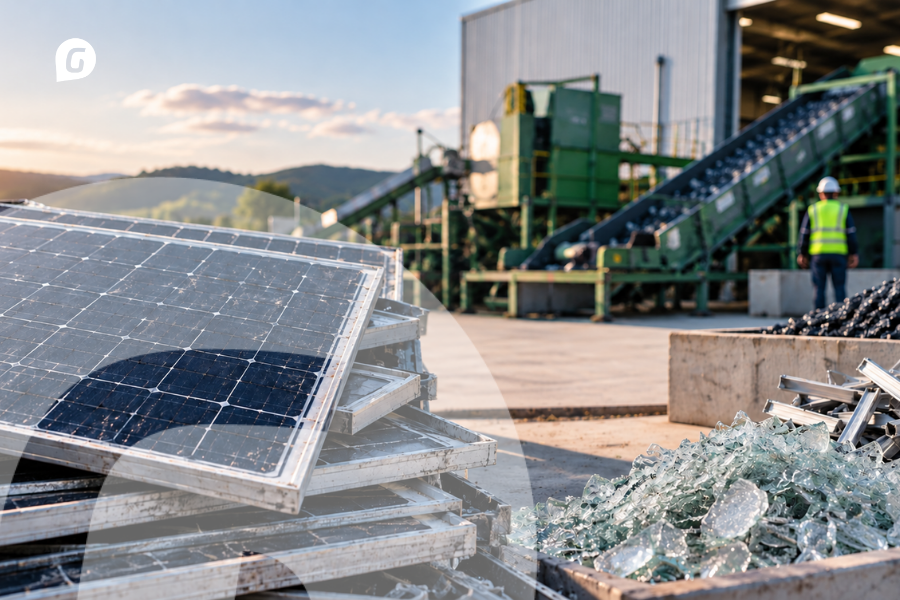
Spain is entering a new stage of the energy transition. After years of accelerated growth in solar energy, a new question is becoming increasingly important: what happens to solar panels when they reach the end of their useful life?
The answer lies in developing collection, treatment, and recycling infrastructure capable of managing the growth of photovoltaic waste while, at the same time, recovering materials that still retain significant industrial value.
The first data already show that solar panel recycling in Spain is growing. In 2025, Recyclia managed 6,443 tons of photovoltaic panels, 21.8% more than the previous year. And everything indicates that this flow will continue to increase.

Spain: one of Europe’s major solar markets
The growth of photovoltaic recycling is directly related to the expansion of solar energy. As of December 31, 2025, Spain had nearly 50 GW of installed solar photovoltaic capacity. During that same year, an additional 8.8 GW of photovoltaic capacity was added to the electricity system.
Solar photovoltaic energy has thus become the technology with the largest presence within Spain’s installed capacity mix. This growth represents a fundamental step forward for the energy transition, but it also poses a new challenge: properly managing solar panels when they reach the end of their useful life.
Solar panels are designed to operate for decades. However, some may be removed earlier due to damage, defects, degradation, weather events, repowering, or technological replacements.
Therefore, photovoltaic waste is not exclusively a future problem. It is already part of energy system management.
Solar panel recycling is growing in Spain
The 2025 data show that photovoltaic module recycling is gaining scale. The 6,443 tons managed by Recyclia represent an increase of 21.8% compared with 2024. But this figure must be understood within a much broader context.
Installed photovoltaic capacity in Spain continues to grow and, with it, the number of modules that will need to be managed in the coming years.
The question, therefore, is not only how much photovoltaic waste is being generated today, but what industrial capacity Spain needs to manage and recover the value of the volume of solar panels that will reach the end of their useful life in the coming decades.
The Government promotes a new renewable recycling industry
The circular economy of renewable energy equipment has also become an industrial priority.
In March 2026, MITECO published the results of the first call for the RENOCICLA program, which mobilizes €86.1 million for 47 projects related to recycling, reuse, ecodesign, and industrial research linked to renewable technologies.
Among the selected initiatives, 15 projects are dedicated to the treatment and recycling of photovoltaic solar panels.
The selected initiatives commit a total investment of €216.8 million and are part of a strategy aimed at recovering raw materials and creating new industrial value chains around waste from clean technologies.
It is a clear sign: solar panel recycling is moving from being a secondary activity to becoming a strategic part of the renewable energy value chain.
Solar panel recycling is not only an environmental challenge
Recycling solar panels is, of course, an environmental issue. But it is also an industrial issue. A photovoltaic module contains glass, aluminum, copper, silicon, plastics, and other materials that can be recovered and reintroduced into different production chains.
The objective should not simply be to prevent a panel from ending up as waste. It should be to recover as much value as possible from the materials that make it up.
In a context of growing demand for raw materials, this recovery can help reduce dependence on virgin resources and strengthen the availability of secondary raw materials.
Solar panels are small “mines” of materials
A panel that stops producing electricity does not necessarily stop having value. Its glass, aluminum, copper, silicon, and other materials remain resources.
That is why modules at the end of their useful life can be understood as true “mini-mines” of raw materials.
IRENA estimates that accumulated waste from solar projects worldwide could exceed 200 million tons by 2050. In a scenario compatible with 1.5°C, more than 17.7 million tons of raw materials could be recovered from this waste, generating around $8.8 billion in value.
The challenge is to develop processes capable of recovering these materials while preserving as much value as possible.
How is a solar panel recycled?
Solar panel recycling involves different stages of collection, preparation, separation, and recovery in order to recover the materials that make up the module.
- Collection and logistics: The modules are removed from the installation and transported to a specialized facility.
- Reception and preparation: The panels are classified and prepared for treatment.
- Extraction: Components and elements that can be separated beforehand are removed.
- Fragmentation: The compact structure of the module is processed to facilitate the separation of its different fractions.
- Classification and separation: The different material fractions are separated.
- Purification and recovery: The recovered materials are processed so they can be reintroduced into new value chains.
The technological difficulty lies precisely in achieving this separation without unnecessarily degrading the materials.
Relive: closing the loop of solar energy
In this context, a new opportunity is emerging for Spanish industry. Relive, a joint venture between Greening and Tradebe specializing in the recycling and recovery of solar panels, is working to develop a solution for managing these modules at the end of their useful life.
Its approach integrates waste management from collection and logistics to treatment and material recovery.
Relive’s process is designed to recover more than 99% of the materials from the panels treated, transforming photovoltaic waste into new secondary raw materials. The recovered fractions include glass, copper, aluminum, plastics, and different metal fractions.
The objective is to move from a linear model: extract → manufacture → use → discard toward a circular model: extract → manufacture → use → recover → reuse.
Spain needs to anticipate photovoltaic waste
Spain’s solar expansion is an extraordinary opportunity to advance the energy transition. But that transition will be more complete the better the entire life cycle of its technologies is managed.
The growth of solar panel recycling, new industrial investments, and the support of programs such as RENOCICLA show that Spain is already building part of that infrastructure.
This trend is not exclusive to Spain. France is also making progress in the management and recovery of solar modules at the end of their useful life, as part of a trend extending to other European markets.
And not only because it is the right thing to do from an environmental perspective. It also makes sense from an industrial perspective: old panels are small mines of materials that we must recover and make use of.
Solar energy does not end when a panel stops producing electricity. A new opportunity then begins: recovering its materials and returning them to the economy.