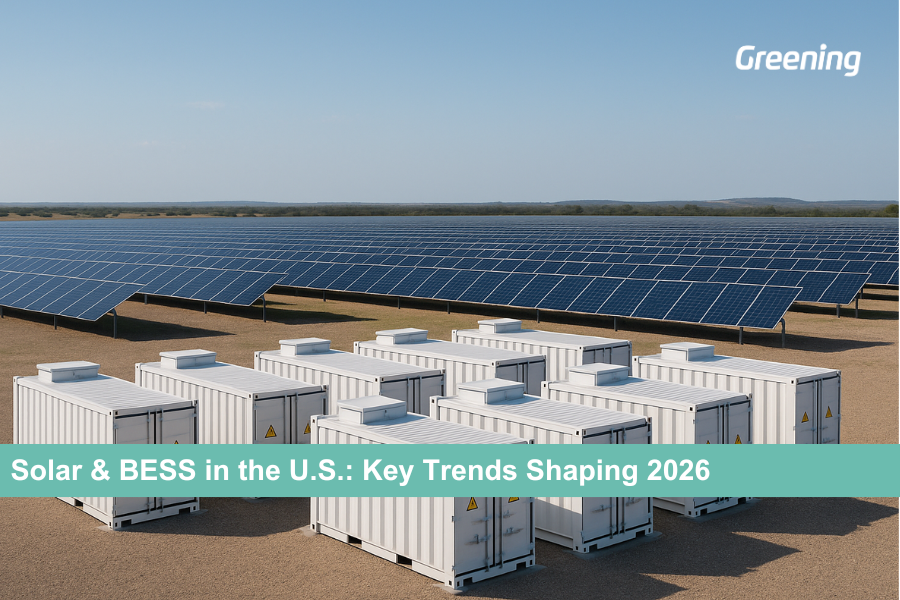
Utility-scale solar power plant with battery energy storage systems (BESS) illustrating key U.S. solar and BESS market trends in 2026.

Solar & BESS in the U.S.: Key Trends Shaping 2026


As 2026 gets underway, the U.S. solar and battery energy storage (BESS) market is entering a defining phase. These U.S. solar and BESS market trends 2026 reflect a shift toward scale, optimization, and long-term resilience across the energy system.

This outlook highlights the most relevant solar and BESS trends shaping the U.S. market in 2026, combining insights from leading industry reports, energy outlooks, and clean technology analyses, with a clear focus on what they mean for the American energy landscape. 

Utility-scale solar photovoltaic plant in the United States, illustrating solar generation trends shaping the U.S. solar and BESS market in 2026.

Solar growth continues, but with a more disciplined pace 

According to Deloitte’s U.S. Renewable Energy Industry Outlook, solar is expected to remain the largest source of new electricity generation capacity additions in the United States through 2026. After record installations in 2023 and 2024, annual solar capacity additions are projected to stabilize but still exceed 30–35 GW per year, keeping cumulative U.S. installed solar capacity on a strong upward trajectory (Deloitte, 2025). 

Utility-scale and distributed solar remain central pillars of the U.S. energy transition. While the record-breaking installation volumes seen in the mid-2020s are expected to stabilize, total installed solar capacity continues to expand steadily. Industry projections indicate that solar will remain one of the largest sources of new generation capacity added in the United States through 2026, supported by declining technology costs and persistent demand for clean, domestic energy. 

In the commercial and industrial (C&I) segment, companies are increasingly adopting solar not only to meet sustainability goals, but also as a financial hedge against long-term electricity price volatility. Rising grid congestion, regional capacity constraints, and exposure to wholesale market fluctuations are reinforcing the value of onsite and contracted solar solutions. 

Rather than signaling a slowdown, this more measured growth reflects a maturing market, one that is prioritizing project quality, interconnection strategy, and long-term performance over rapid expansion alone. 

Battery energy storage becomes essential, not optional 

Battery energy storage (BESS) is the fastest-growing segment of the U.S. power sector. S&P Global estimates that U.S. grid-scale battery capacity will grow at a compound annual growth rate (CAGR) of more than 20% through 2026, driven by renewable integration needs, capacity constraints, and market opportunities in ERCOT, CAISO, MISO, and the Southeast (S&P Global, 2025). 

If solar defines the generation backbone of the U.S. clean energy system, battery storage defines its flexibility. By 2026, BESS is no longer viewed as an add-on, but as a core component of new solar developments and grid planning strategies. 

Across key U.S. markets such as Texas, California, the Midwest, and the Southeast, battery installations are accelerating to address peak demand, manage intermittency, and improve grid reliability and flexibility. By 2026, total installed U.S. battery storage capacity is expected to surpass 60–70 GW, compared to less than 20 GW at the start of the decade, underscoring how quickly storage has moved from niche to necessity (Energy Evolution Conference analysis, 2025). Storage duration is also evolving, with four-hour systems becoming standard and longer-duration solutions gaining attention for capacity and resilience needs.

For utilities, storage enables better integration of renewables while reducing reliance on peaker plants. For corporate energy buyers, BESS enhances the value of solar through solar-plus-storage projects, enabling demand charge management, backup power, and participation in emerging grid services markets.

Grid constraints and interconnection drive smarter project design 

Interconnection remains one of the most significant bottlenecks for solar and storage deployment in the United States. According to S&P Global, more than 2,000 GW of generation and storage projects were sitting in interconnection queues as of 2024, with solar and hybrid solar-plus-storage projects representing the majority (S&P Global, 2025).

One of the most influential trends shaping solar and storage deployment in 2026 is not technological, but structural: grid congestion. Interconnection queues across the U.S. remain lengthy, particularly in high-growth regions. As a result, developers are increasingly optimizing projects around grid realities rather than ideal site conditions alone.

Hybrid solar-plus-storage projects are becoming a strategic response to these challenges, allowing developers to better control export profiles and maximize interconnection capacity. At the same time, there is a growing emphasis on early-stage grid analysis, flexible system sizing, and creative offtake structures to improve project bankability.

In this environment, experience, engineering expertise, and a deep understanding of regional transmission dynamics are becoming decisive competitive advantages. 

Corporate demand and long-term power strategies evolve 

Corporate renewable energy procurement continues to be a key demand driver in the United States. Deloitte reports that large commercial and industrial buyers have contracted over 200 GW of renewable capacity globally, with the U.S. accounting for the largest share. In 2026, corporate buyers are increasingly prioritizing projects that provide dispatchable clean energy rather than energy-only profiles (Deloitte, 2025).

U.S. corporations remain a major driver of renewable energy demand, but their approach is evolving. In 2026, many large energy buyers are shifting from purely volume-based procurement to more sophisticated strategies that balance cost, risk, and reliability. 

This includes increased interest in: 

  • Solar and storage solutions that provide both energy and capacity value
  • Hybrid PPAs that combine renewable generation with storage-backed delivery profiles
  • Regional sourcing strategies aligned with load centers and grid constraints


As ESG commitments mature, companies are also placing greater emphasis on additionality and emissions reductions within the U.S. market.

Grid-scale battery energy storage systems (BESS) supporting solar integration and grid flexibility in the U.S. energy market.

Technology innovation focuses on efficiency and integration 

Technology innovation in 2026 is centered on efficiency, integration, and reliability. According to industry analyses highlighted by S&P Global, average utility-scale solar module efficiencies deployed in the U.S. are now exceeding 22% module efficiency, while advances in digital asset management are improving plant-level performance and reducing curtailment risk.

While dramatic cost declines have characterized the past decade, innovation in 2026 is focused on performance optimization rather than disruption alone. Advances in inverter technology, monitoring, and control systems are improving output and reducing operational risk across solar assets.

In parallel, BESS technology is benefiting from improved energy density and safer chemistries, as well as more sophisticated control software. These improvements are enabling better integration with solar plants, grid systems, and customer load profiles, reinforcing the role of storage as a multi-use asset rather than a single-function solution.

Policy stability matters more than expansion 

The policy environment in the United States remains supportive but increasingly execution focused. Deloitte notes that while federal incentives continue to underpin project economics, long-term growth through 2026 will depend more heavily on policy stability, permitting reform, transmission expansion, and grid modernization than on new subsidy mechanisms (Deloitte, 2025).

In 2026, the policy landscape is defined less by new incentives and more by the effective execution of existing frameworks. Market participants are focused on regulatory clarity, permitting efficiency, and transmission investment as the next enablers of growth.

Rather than relying solely on policy-driven economics, solar and storage projects are increasingly expected to stand on their own financial and operational merits. This shift further underscores the importance of disciplined development, reliable EPC execution, and long-term asset performance.

Looking ahead: a resilient and strategic market 

The U.S. solar and BESS market trends 2026 point to a sector that is not slowing down, but leveling up. Growth continues, but with greater emphasis on grid stability and energy management, resilience, and strategic value. Solar remains a cornerstone of new power generation, while battery storage has become indispensable to the modern energy system.

For stakeholders across the energy ecosystem, success in 2026 will depend on the ability to navigate grid complexity, align projects with real-world demand, and deliver resilient renewable energy solutions that combine clean energy with reliability and cost certainty.

At Greening US, we see this moment as an opportunity to build smarter, more resilient renewable energy solutions designed not just for today’s market, but for the energy system the United States will rely on in the decades ahead.

Ready to plan your 2026 energy strategy? 

Whether you are evaluating solar, battery storage, or hybrid solutions, having the right partner makes all the difference. From early-stage project development to fully integrated solar and BESS solutions, we work with corporate energy buyers, developers, and utilities to deliver reliable, cost-effective clean energy projects across the United States.

If you are planning your renewable energy strategy for 2026 and beyond, now is the time to start the conversation. Contact us.
Share

More articles

Do you have any questions about this blog or our services?

Contact our team and tell us what you need.

Get in touch
with us

Lucía Lampón - GD DIRECTOR SPAIN

An Industrial Engineer specialized in energy, sustainability, and operations management, she brings more than 15 years of experience in the energy and renewable energy sectors. Throughout her career, she has held leadership positions across technical, production, and operational areas, leading multidisciplinary teams and managing power generation projects for leading companies in the industry. Her expertise spans project development, technical management, process optimization, and comprehensive operations management, combining a strong technical background with a strategic vision focused on efficiency and operational excellence. Currently, as Head of Distributed Generation Spain at Greening, she drives the growth and consolidation of the company’s distributed generation business, contributing to the development of sustainable energy solutions and strengthening Greening’s position in the market.

Arianna Tinaburri – CLO ITALY (Chief Legal Officer Italy)

texto

Alejandro Ruiz – COUNTRY MANAGER ITALY

texto

Christof Glasmacher – Key Account Manager

In dieser Rolle verantwortet er die strategische Betreuung und Weiterentwicklung von Schlüsselkundenbeziehungen. Mit einem klaren Fokus auf nachhaltige Lösungen und partnerschaftliche Zusammenarbeit entwickelt er individuelle Konzepte, die sowohl ökologische als auch wirtschaftliche Mehrwerte schaffen.

Seit über 30 Jahren ist er im Vertrieb erklärungsbedürftiger technischer Produkte tätig und bringt umfassende Erfahrung in der Kundenbetreuung und Projektentwicklung mit.

Durch seine ausgeprägte Kundenorientierung, Marktkenntnis und Kommunikationsstärke trägt er maßgeblich zum Wachstum und zur Positionierung der Greening GmbH als innovativen Anbieter im Bereich nachhaltiger Technologien bei.

Sein Fokus liegt auf nachhaltigen Energielösungen und der partnerschaftlichen Zusammenarbeit mit Kunden und Ingenieuren.

Josu Egea – Country Manager Germany

Geschäftsführer mit über 20 Jahren Erfahrung in der Leitung technischer und multidisziplinärer Teams in anspruchsvollen internationalen Umgebungen.

Josu verfügt über umfassende Erfahrung in den Bereichen erneuerbare Energien, Photovoltaik und Energiespeichersysteme (BESS), mit einem klaren Fokus auf Innovation, operative Effizienz und nachhaltiges Wachstum. Experte für Verhandlungsführung, kaufmännisches Management, industrielle Abläufe und internationale Geschäftsentwicklung.

Josu hat eine fundierte technische Ausbildung als Industrieingenieur, ergänzt durch einen MBA, wodurch er seine strategischen Visionen mit der operativen Umsetzung optimal verbinden kann.

Pilar Monzón Rubio – Head of Development – Investments

Pilar Monzón leitet den Bereich Projektentwicklung für Erneuerbare Energien bei der Greening Group in Deutschland, mit Sitz in der Zentrale in Düsseldorf. Sie ist verantwortlich für die Expansionsstrategie von Investments auf dem deutschen Markt und koordiniert alle Phasen der Projektentwicklung – von der Identifikation von Chancen bis hin zur Strukturierung und Umsetzung.

Mit über einem Jahrzehnt Erfahrung im Bereich Erneuerbare Energien, Ingenieurwesen und Unternehmensentwicklung in Deutschland bringt Pilar eine strategische Sichtweise, eine hohe Umsetzungskompetenz und eine klare Ergebnisorientierung mit. Ihr Führungsstil basiert auf sorgfältiger Analyse, der Zusammenarbeit mit interdisziplinären Teams und einem starken Engagement für Nachhaltigkeit als Wachstumsmotor.

Sie ist Architektin und besitzt einen Master in Energiemanagement und Internationalisierung von Projekten, eine Ausbildung, die ihren technischen Fokus stärkt und ihr eine globale Sichtweise verleiht, die an anspruchsvolle regulatorische Rahmenbedingungen angepasst ist.

Hartmut Bergs – Head of Operations Germany

Hartmut Bergs ist ein erfahrener Bau- und Projektmanager mit über 20 Jahren internationaler Expertise in erneuerbaren Energien, Industrie- und Großbauprojekten. 

Seit Dezember 2023 leitet er als Head of Operations bei der Greening Group operative Abläufe und Projektumsetzungen. 

Zuvor verantwortete er bei EnviTec Biogas AG, ENERCON und weltweit Bau, Installation und Inbetriebnahme komplexer Anlagen im Bereich Biogas und Windenergie. Seine Karriere begann er als Bauleiter im Industrie- und Photovoltaikdachbau bei Pohlen Bedachungen/ Solar sowie als Bauleiter in der Petrochemie.
Absolvent der Rheinischen Fachschule Köln als staatlich geprüfter Techniker für Hochbau und Fachkraft für Arbeitssicherheit, verfügt er über ausgeprägte Führungsqualitäten in der Leitung großer, multinationaler Baustellenteams. Mit technischer Präzision, Organisationsstärke und einem hohen Sicherheitsbewusstsein sorgt er für den reibungslosen Ablauf und die erfolgreiche Umsetzung komplexer Projekte im internationalen Umfeld.

Antonio Nievas – COO Solutions

Master Civil Engineer with an MBA and C-Suite executive education from IESE, with additional specializations in corporate sustainability and renewable energy investment and financing. He has over 25 years of senior management experience in both large-scale civil infrastructure and energy sectors.

He has led complex projects and strategic initiatives in national and international markets, including Ireland, United Kingdom, and, for the past 12 years, United States. His profile combines strong technical expertise with strategic vision, contributing to innovation and operational excellence. 

Tobias Deissler - Head of Business Development USA

Originally from Germany, Tobias is the Chief Commercial Officer (CCO) of Greening  and has over 16 years of experience in the renewable energy sector. He joined Greening Ingeniería in 2019 as Managing Director, leading the company’s international expansion since then. Tobias holds a degree in Civil Engineering and a master’s in international economics. He began his professional career in Germany, where he gained experience in Procurement and Logistics at companies such as Berner Group and Riese & Müller. Throughout his career, he has held international leadership positions, including Chief Operating Officer (COO) of the Assyce Group in Spain and Managing Director of its Asian division.

Adrian Ortega – Development Director USA

Development Director at Greening USA, where he leads the full-cycle development of large-scale energy projects. With a degree in Industrial Engineering from the Polytechnic University of Madrid and an MBA from the Granada Chamber of Commerce, Adrian brings strong technical and strategic insight to the company. Since joining Greening in 2019, he has developed solar projects across Spain, Mexico, and the United States. His expertise includes resource assessment, technical and economic feasibility analysis, and the design, optimization, and management of energy recovery facilities.

Claudia Pastor – Finance Director USA

Finance Director for Greening USA, overseeing financial operations and tax planning across North America. With over 12 years of experience in international finance and strategic planning, including the last 7 years dedicated to the solar photovoltaic industry, she brings deep sector knowledge and a global perspective to the team. Her role is pivotal in ensuring full regulatory compliance while driving the company’s long-term financial sustainability and growth in the region. Claudia’s leadership strengthens Greening’s position as a reliable and future-ready partner in the U.S. renewable energy market.

Florencia Ortiz – Head of Legal USA

Head of Legal at Greening USA, where she leads all legal, commercial, and regulatory matters for the region. With extensive experience advising multinational companies in the renewable energy and infrastructure sectors, she serves as both in-house and external counsel on complex transactions and regulatory compliance across the U.S., Brazil, and Argentina. Her legal expertise and strategic counsel play a key role in ensuring the success and integrity of Greening’s operations in dynamic and highly regulated markets.

Alejandro Ruiz – Director of Greening Europe

A Civil Engineer with an Executive MBA from Luiss Business School, he has built a strong international career in the renewable energy sector and infrastructure project management. With more than a decade of experience in business development and operational leadership, he successfully led Greening’s expansion in Italy and currently oversees the company’s European operations as European Director. Specialized in corporate strategy, business development, project execution, and organizational transformation, he combines a global perspective with deep local market expertise to drive sustainable growth, coordinate multidisciplinary teams, and create long-term value across international markets.

Pablo Otín – CEO (Chief Executive Officer)

CEO of Greening since 2026, where he leads the Group’s global strategy and oversees the execution of its renewable energy businesses. He brings more than 20 years of experience in the energy sector, with a strong track record in the development, financing, and management of utility-scale solar photovoltaic and battery energy storage system (BESS) projects. Throughout his career, he has held executive positions at leading international companies such as Grenergy, Powertis, Gestamp Solar, and Gamesa, participating in large-scale energy projects and leading international teams across multiple markets. He specializes in greenfield project development, structured finance, mergers and acquisitions (M&A), power purchase agreements (PPAs), asset management, and cost optimization, playing a key role in driving the growth and international expansion of renewable energy companies.

Sergio Prado - Director of Greening North America

General Manager of Greening USA, responsible for executing the company’s strategic vision and expansion across the North American market. With a background in chemical engineering and a Master’s in Sustainable Energy Systems from the University of Edinburgh, he brings a strong technical foundation and industry insight. Throughout his career, Sergio has held leadership roles in various companies specialized in photovoltaic energy, building a track record of successful growth and market entry strategies. His combined experience in engineering, sales, and management makes him a key driver of Greening’s growth in the United States.

Felipe García - CFO (Chief Financial Officer)

Chief Financial Officer (CFO) of Greening since 2026, where he leads the Group’s financial strategy and supports the execution of its growth plan and long-term value creation for shareholders. He brings extensive international experience in finance roles across the energy and consulting sectors. Before joining Greening, he held several senior leadership positions at Siemens Gamesa, including Managing Director Finance and Finance Head EMEA, overseeing financial operations in complex multinational environments. Prior to that, he spent more than eight years at EY, specializing in due diligence processes and financial structuring for major transactions involving private equity funds, financial institutions, and industrial companies.

Isidro Ramírez - CHRO (Chief Human Resources Officer)

He holds a degree in Business Administration and has developed his career in highly dynamic environments, ranging from the retail sector to the technology and financial industries, including Spain’s first credit rating agency. He is a specialist in talent development, innovative people management, and organizational transformation, with extensive experience in M&A processes and company integrations. With over 25 years of experience leading complex projects and international strategies, he combines strong technical expertise with broad executive experience, enabling him to drive innovation and operational excellence in any organization.

Raquel Lacilla - CLO (Chief Legal Officer)

She holds a dual degree in Law and Business Administration from the University of Zaragoza, with additional studies at the University of Bologna, and is a member of the Madrid Bar Association (ICAM). She has over 15 years of experience in corporate legal advisory, particularly in the renewable energy and infrastructure sectors. She currently serves as Global Legal & Compliance Director at Greening Group, and as Non-Director Secretary of the Board of Directors and its delegated Audit and Appointments & Remuneration Committees. She has held key positions at ENGIE Spain and SICE (part of the ACS Group, now under Vinci Group), and has practiced as a corporate lawyer and external advisor to companies in law firms in Spain and Ireland, specializing in corporate, contractual, and financial matters.

María Dolores Cuadrado - GMD Assistent

Titulada en Secretariado de Dirección Bilingüe y Licenciada en Ciencias Políticas y Sociología posee una larga trayectoria desarrollando el rol de Asistente de Dirección en empresas multinacionales como ITM Ibérica, apoyando a la alta dirección en la organización, planificación y gestión de tareas clave. Esta experiencia le ha permitido adquirir una gran capacidad de organización, comunicación efectiva y un enfoque resolutivo en entornos exigentes. Además, cuenta también con amplia experiencia profesional en el area comercial y de atención al cliente, trabajando en diferentes sectores y liderando equipos orientados a resultados.

D. Ignacio Salcedo Ruiz - Executive Chairman

Co-founder and Executive Chairman of Greening. Since founding the group in 2011, he has led its growth into an integrated energy platform with an international presence across Europe, the Americas, and Africa. Holding a degree in Civil Engineering from the University of Granada and an Executive MBA from EOI Business School, he has built a strong track record in the development, engineering, and execution of energy projects. Under his leadership, Greening has established a vertically integrated business model spanning power generation, engineering, energy retail, and technology-driven solutions for the energy transition. As Executive Chairman, he currently oversees the group’s corporate strategy and business development, driving its international expansion and new growth initiatives within the renewable energy sector.